A hands-on look at whether this lifetime deal is worth your money in 2026.
If you’ve ever tried to figure out where a photo came from, whether someone stole your work, or if an image floating around the internet is even real anymore, you already know the pain. Google’s built-in reverse image search is fine for casual curiosity, but the moment you need something more serious — legal-grade proof, a full list of every site hosting your photo, or a way to tell if an image was cooked up by AI — it falls flat. That gap is exactly where Copyseeker steps in, and after digging through what it offers, I wanted to break down whether it’s actually worth adding to your toolkit.
What Exactly Is Copyseeker?
Copyseeker is a reverse image search platform built for people who need more than a quick guess at where a picture came from. Instead of relying on a single search index the way most free tools do, it pulls results from multiple search engines at once and layers AI analysis on top. The result is a tool that catches matches other services routinely miss — cropped versions, edited copies, screenshots, and images that have been resized or color-adjusted to dodge detection.
It’s positioned less as a novelty gadget and more as working software for people whose job or reputation depends on knowing where an image has traveled. Think photographers chasing down stolen work, insurance adjusters checking whether a submitted photo is genuine, journalists tracing a viral image back to its source, or marketing teams keeping tabs on brand assets floating around the web unlicensed.
How It Actually Works
The workflow is refreshingly simple, which is a nice change from tools that bury useful features behind a maze of settings.
- Upload an image — drag and drop a file, paste a URL, or pull one straight from your device.
- Let the AI do the heavy lifting — it studies visual patterns, colors, composition, and any available metadata rather than just matching pixels.
- Review results instantly — you get a list of where the image appears, related or altered versions, and a read on whether it looks AI-generated.
No lengthy setup, no confusing dashboards. You upload, wait a few seconds, and get a results page you can actually act on.
The Features That Set It Apart
What impressed me most is that Copyseeker doesn’t just do one thing well — it bundles several genuinely useful capabilities into one subscription instead of forcing you to stitch together three or four separate tools.
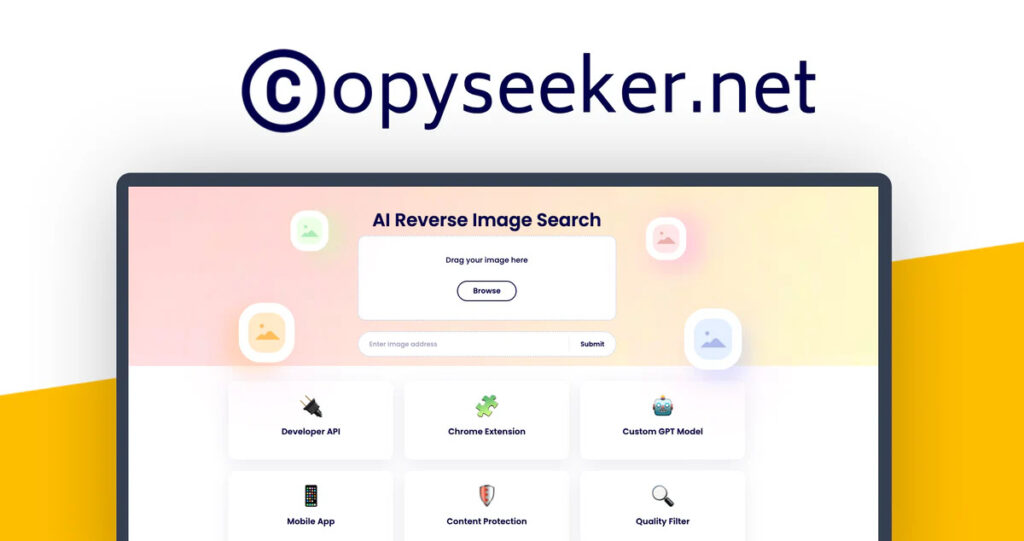
- Premium Reverse Image Search — casts a wider net than typical tools, surfacing matches that standard search engines quietly skip over.
- AI Image Detector — flags whether an image was likely generated by AI, which is becoming essential now that synthetic photos are everywhere.
- Multi-Engine Search — combines several image search engines into a single query instead of making you check each one manually.
- Developer API — lets technical teams bake reverse image search directly into their own apps or internal tools.
- Chrome Extension — search any image on the web without leaving the page you’re browsing.
- Custom GPT Integration — useful for anyone already running research or investigative workflows through AI assistants.
- Mobile App — a native iOS app with camera integration, so you can search an image the moment you spot it.
- Content Protection Monitoring — keeps an eye on your images over time and alerts you to unauthorized copies.
- Quality Filtering — strips out spammy, low-value results so you’re not wading through junk to find what matters.
Copyseeker also claims a matching accuracy above 95 percent, and says it can still identify an image even after it’s been cropped, watermarked, resized, or had its colors adjusted — the kinds of edits people typically make specifically to avoid detection.
Get Copyseeker to make changes.
Who Should Actually Consider This?
This isn’t really a tool built for someone who wants to reverse-search a meme once a year. It earns its keep with people who need reliable, repeated results:
- Freelance photographers and agencies who need to catch unlicensed use of their work before it costs them money.
- Insurance and real estate professionals who need to confirm a submitted photo hasn’t been recycled or doctored.
- OSINT researchers and investigative journalists tracing an image back to its original source.
- Marketers and brand teams monitoring where their visual assets end up online.
- Anyone who just wants a genuinely more accurate reverse image search than what free tools offer.
Pricing: Is the Lifetime Deal Actually a Good Deal?
Here’s where Copyseeker gets interesting. Instead of a monthly subscription that quietly drains your budget every year, Dealify is currently offering a lifetime license for a one-time payment of $135, discounted from a $450 regular price. That single payment reportedly unlocks:
- Lifetime access with no recurring fees
- Unlimited searches
- Priority processing speed
- Access to the advanced AI detection features
- All future feature updates
- Priority customer support
There’s also a 30-day money-back guarantee, so if it doesn’t fit your workflow, you’re not stuck. Compare that one-time cost to typical SaaS pricing in this space, where monthly plans for professional-grade reverse image search can easily run $30 to $50 a month — meaning this deal could pay for itself in under six months for anyone using it regularly, with everything after that being free.
What I Liked
- Genuinely broader results than free reverse-image tools, especially for edited or cropped images.
- The AI-generated image detector is a smart, timely addition as synthetic imagery becomes harder to spot with the naked eye.
- A one-time lifetime payment instead of an endless subscription is a rare and welcome pricing model.
- Useful extras — the Chrome extension and mobile app — mean it fits into how people actually browse and work, not just a standalone dashboard.
- Images are automatically deleted from their servers within 24 hours, which is a reasonable privacy stance for a tool that handles potentially sensitive content.
What to Keep in Mind
- It’s a newer platform, so it doesn’t have the decades of brand recognition that Google Images has — though that’s also exactly why it can outperform bigger, slower-moving tools in coverage.
- An Android app isn’t available yet, which will matter if you’re not on iOS.
- Like any AI detection system, its AI-generated image flagging won’t be flawless in every single case, so it’s best used as a strong signal rather than absolute proof.
Final Verdict
Copyseeker doesn’t try to reinvent reverse image search from scratch — it takes an idea most of us already understand and simply does it better, faster, and with more context than the free tools we’ve all defaulted to for years. The multi-engine approach means fewer blind spots, the AI detection adds real value in an era where telling real from fake is getting harder, and the lifetime pricing model makes it an easy tool to justify even if you only use it occasionally.
For photographers protecting their portfolios, researchers chasing down sources, or businesses that simply want to know where their images are ending up, this is one of those tools that quietly earns its place in your bookmarks bar. At $135 for lifetime access, backed by a 30-day guarantee, it’s a low-risk way to find out if it becomes as essential to your workflow as it has for the professionals already using it.
If you deal with images professionally in any capacity, Copyseeker is worth a serious look before this lifetime pricing disappears.